For women 40, 50, 60 and beyond
Japanese Habits. Western Strength. Built for You.
Seven ready-to-use tools that blend how Japanese women stay strong into later life (interval walking, morning taiso, floor living, eating to 80% full) with two short Western strength sessions a week. At home or outside. No gym.
$47 one time · instant access · $313 if bought separately · watch the free video

The 3:3 walk
3 minutes fast, 3 minutes easy, 5 rounds, 4 days a week.
Photo: Age Cymru / Unsplash
Japan and the West
Two cultures. Two halves of the answer.
The West got strength training right. Japan got the daily habit right. Most plans for women over 40 hand you the punishing half and skip the half that makes it stick. Stronger Season takes the best of each and puts them in one calm week.
Everyday movement
West: Exercise is an appointment: a class or a gym session, then sitting for most of the day.
Japan: Movement is part of the day: walking, stairs, and for many, a short morning routine.
You: Morning Taiso 10, every day, tied to the kettle.
Walking
West: Long walks or jogs at one steady pace.
Japan: Interval walking from Shinshu University: 3 minutes fast, 3 minutes easy.
You: A 12-week ramp, with a coach that times every interval.
Strength
West: Resistance training. Done kindly, this is the West’s best idea.
Japan: Less gym culture. Strength comes from daily life and floor living.
You: Two 20-minute home sessions a week, logged and stepped up.
The floor
West: Chairs and sofas all day. Getting up off the floor becomes rare.
Japan: Traditional homes still use the floor for sitting, tea and sleeping.
You: A monthly floor test and a six-rung practice ladder.
Eating
West: Big plates, “clean your plate”, protein as an afterthought.
Japan: Hara hachi bu: stop at about 80% full. Fish, soy, small dishes.
You: Protein first, then stop at 80%. A plate guide and a calculator.
- Japanese women’s life expectancy in 2024, the world’s highest for the 40th year
- 87.13 yrs
- Japan health ministry, via Arab News Japan
- The year Japan’s 10-minute radio taiso routine was first broadcast
- 1928
- Unseen Japan, radio taiso history
- Minutes fast, then minutes easy, in the Shinshu interval walking method
- 3 + 3
- Nemoto et al., Mayo Clinic Proceedings, 2007
Life expectancy has many causes, including healthcare, diet and genes. We borrow habits, not promises.
The strength quiz
Where should you start?
Four honest questions. You get the three tools to open first, in order.
Four questions, about a minute.
Answer all four and this panel shows which three tools to open first, and why. Nothing is saved or sent.
What is inside
Seven tools, in the order you will use them
Each one answers the question the last one raises. Four work right here in your browser, three are printables and a spreadsheet. Every one is finished and working today.
Not medical advice. Check with your doctor first.
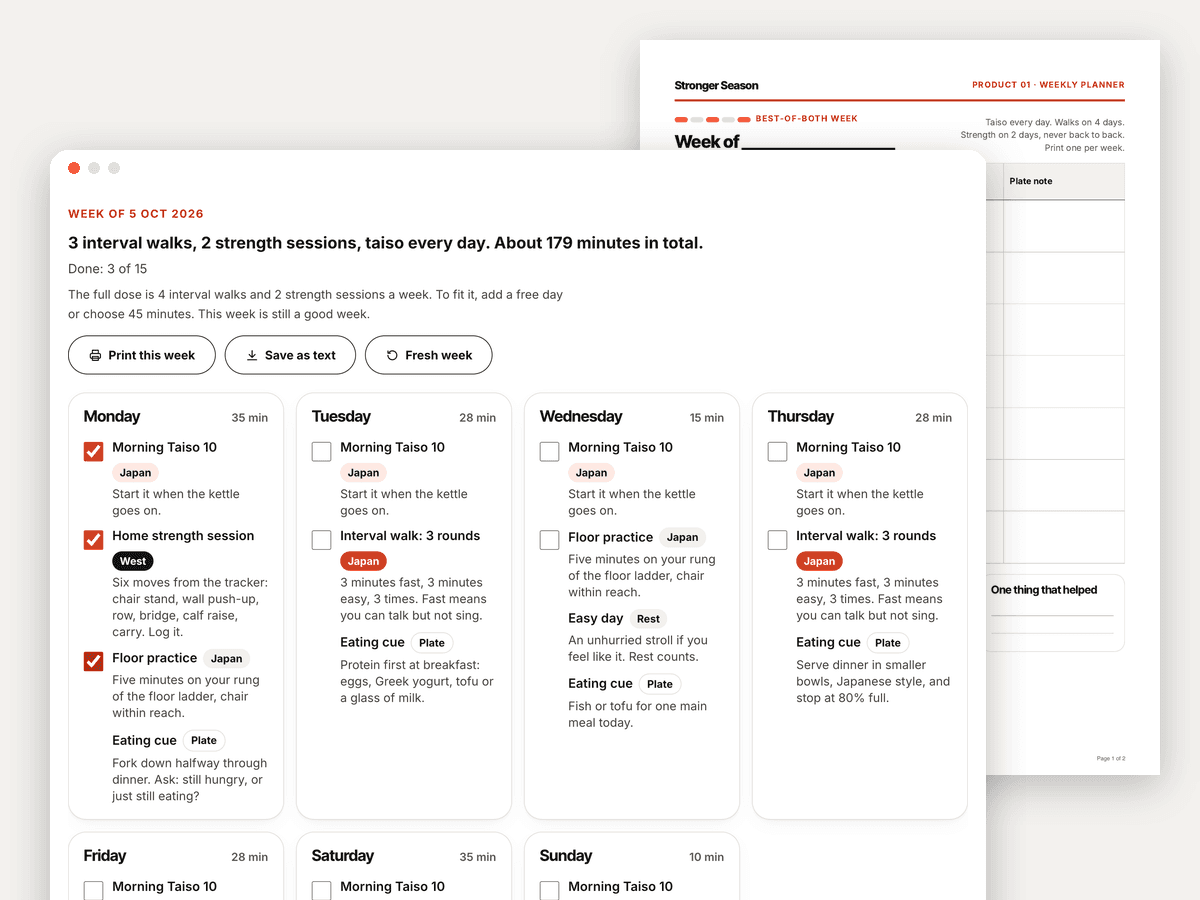 01PlanJapan + West
Best-of-Both Weekly Planner
What do I actually do on Tuesday?
Tell it your free days and minutes. It builds a calm week in four layers: a daily morning routine, interval walks, two short strength sessions and one eating cue a day. Tick it off, print it, start again on Monday.
In-page planner + printable pages 5 minutes on a Sunday
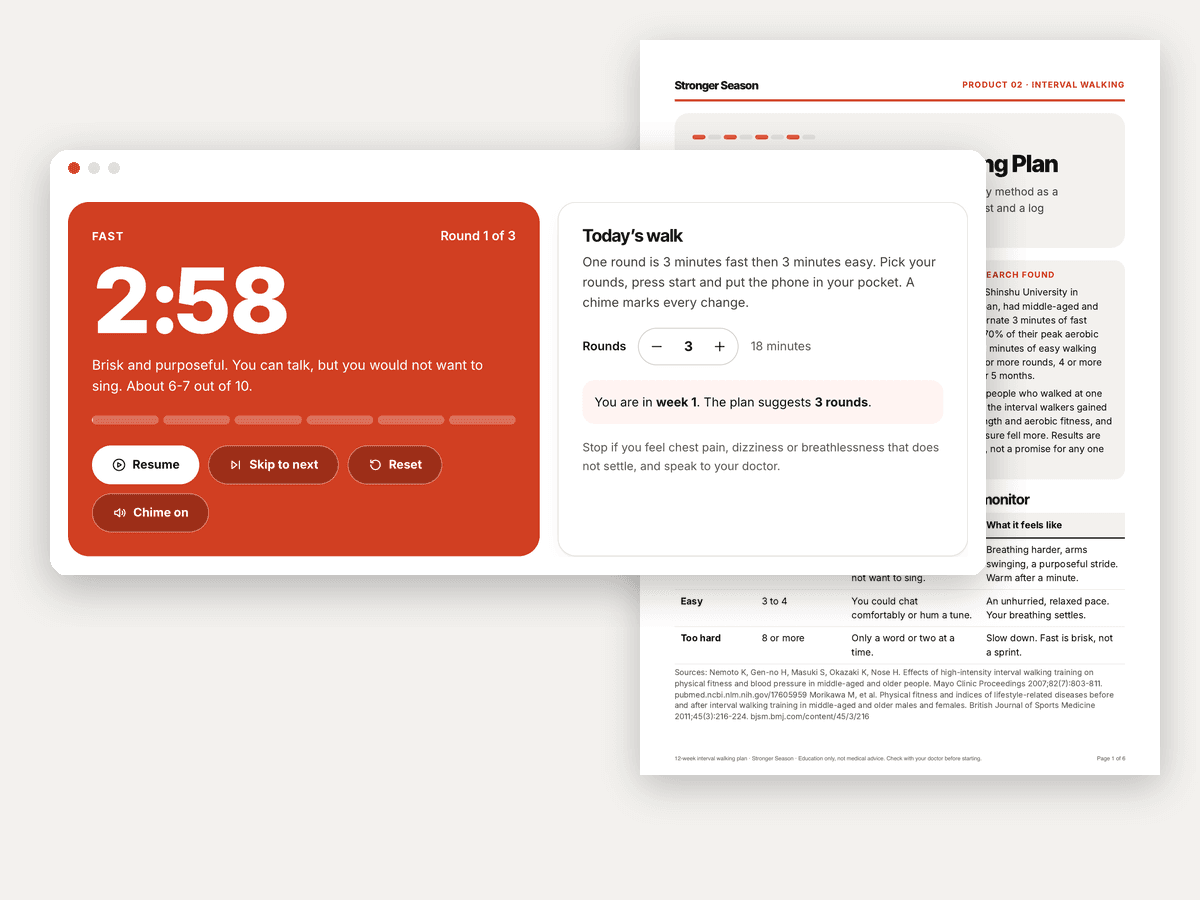 02WalkJapan
12-Week Interval Walking Plan + Coach
How do I do “Japanese walking” properly, and keep it up?
The Shinshu University method, 3 minutes fast and 3 minutes easy, as a gentle 12-week ramp. The coach times every interval with a chime, logs each walk and shows your 12-week grid filling in.
In-page coach and log + printable plan 30 minutes, 4 days a week
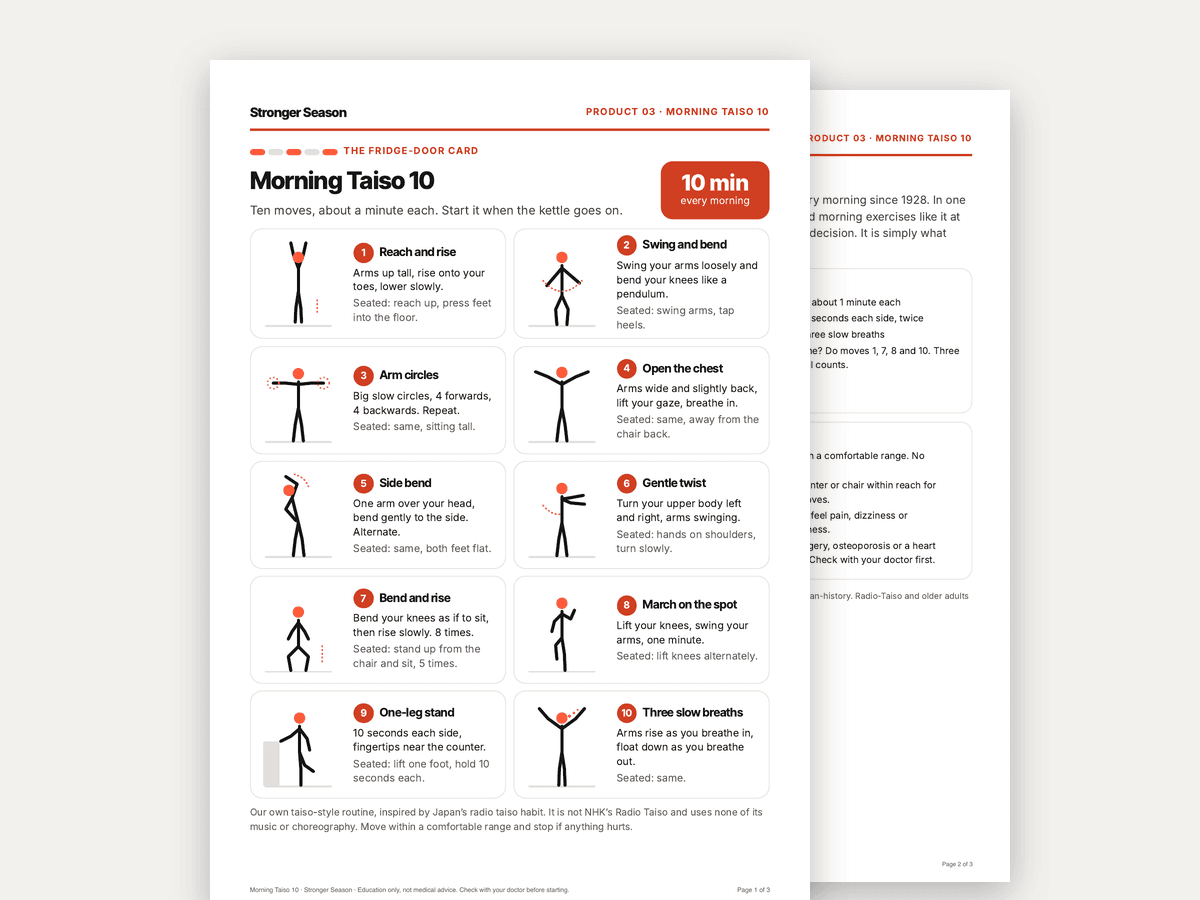 03DailyJapan
Morning Taiso 10
What can I do every morning in ten minutes, even on a bad day?
A ten-move, taiso-style routine on one printable card for the fridge door, with a seated version of every move and a 30-day tick sheet. Our own routine, inspired by Japan’s radio taiso habit.
Printable routine card (PDF) 10 minutes a day
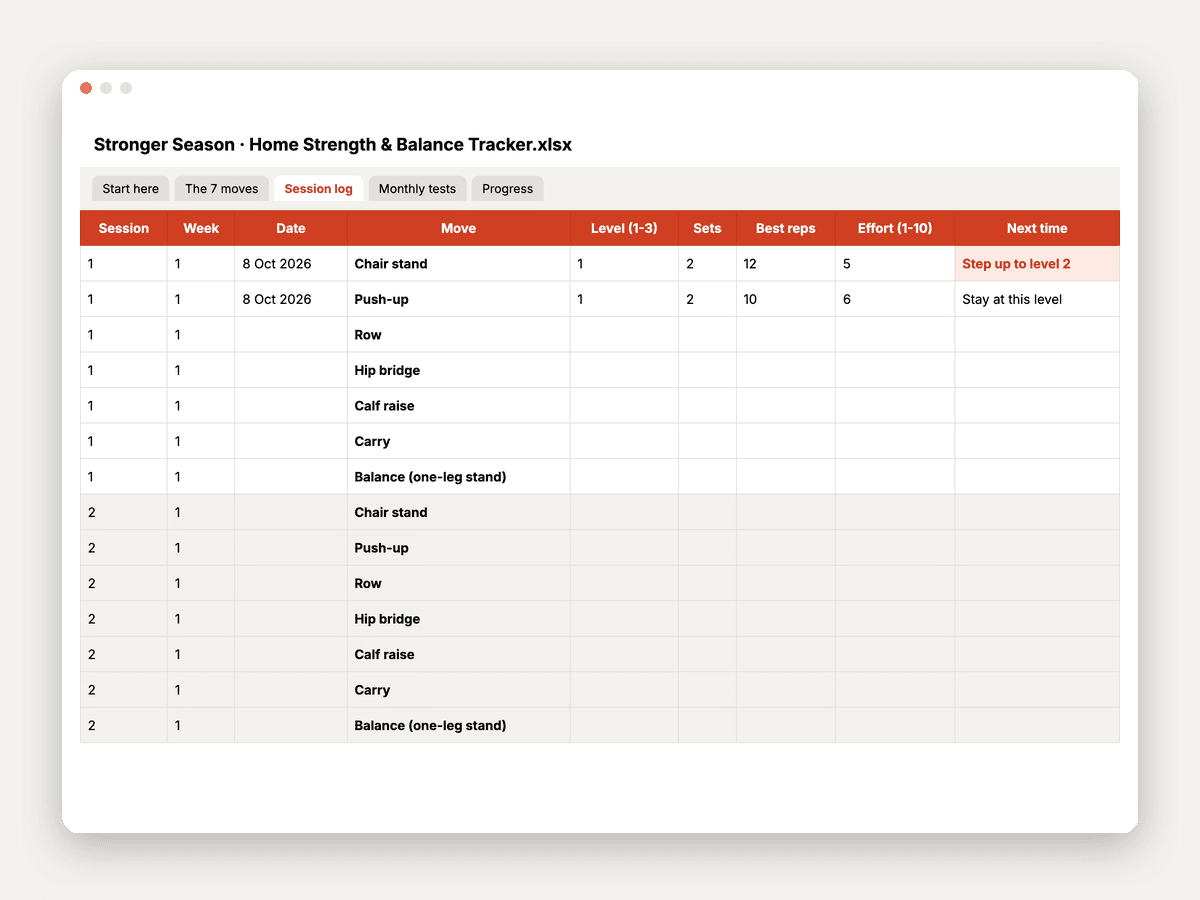 04BuildWest
Home Strength & Balance Tracker
What is the least strength training that still works, at home?
The Western half: six moves, three levels each, two 20-minute sessions a week. A spreadsheet that logs every set, steps you up a level when it gets easy and charts your monthly balance and chair tests.
Spreadsheet (Excel, Google Sheets, Numbers) 20 minutes, twice a week
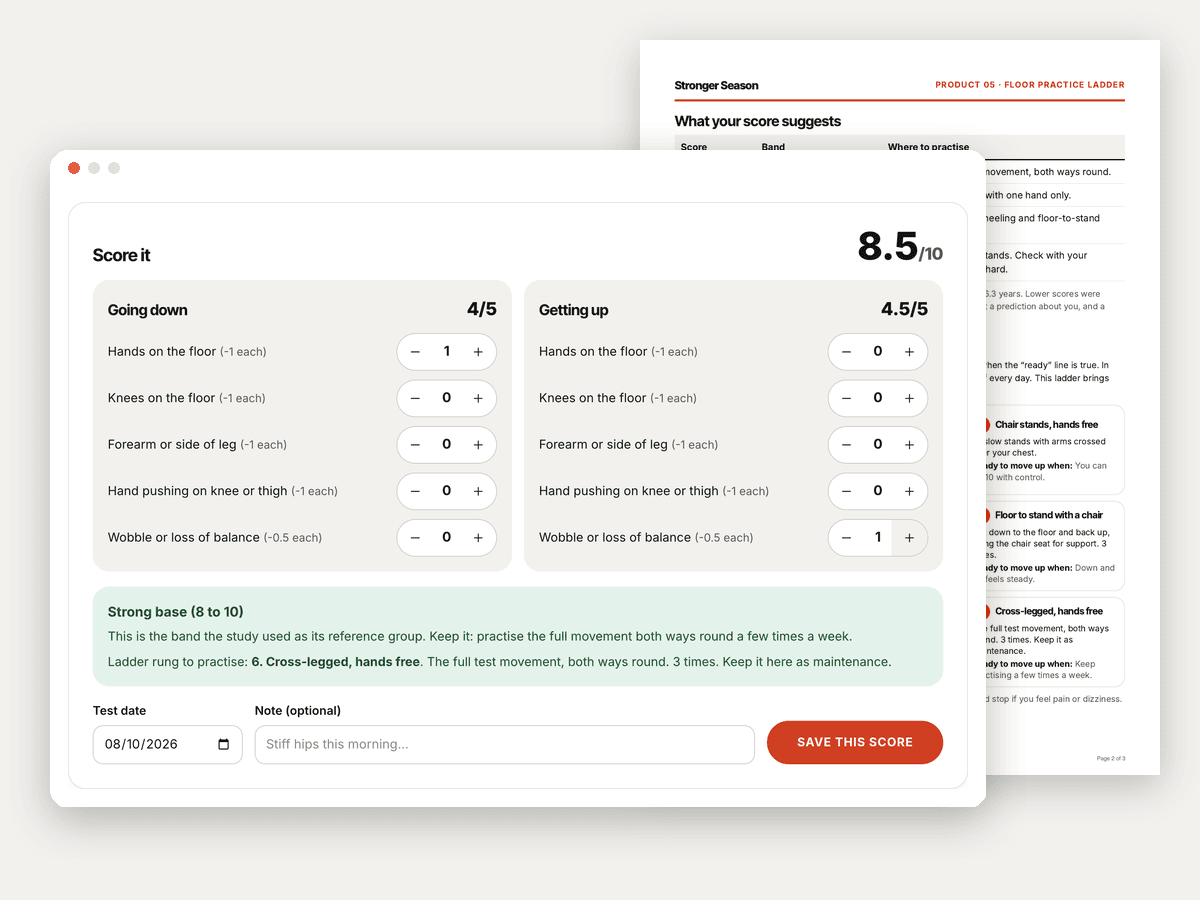 05MeasureJapan + West
Floor Sit-to-Stand Test & Log
Am I actually getting stronger?
The sitting-rising test from the Brito study, scored for you out of 10, saved month by month with a simple chart. A printable floor practice ladder shows which rung to work on next.
In-page test and log + printable ladder 5 minutes, once a month
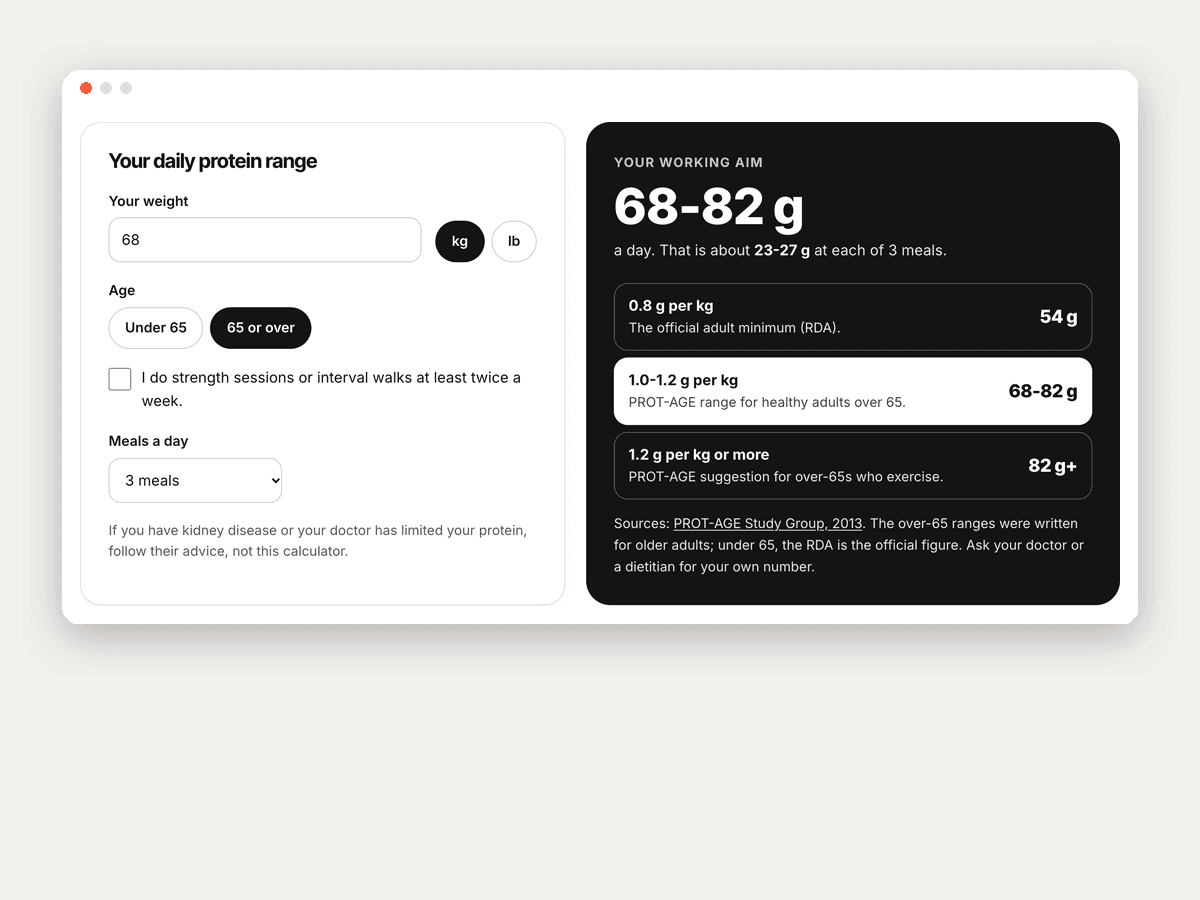 06FuelJapan + West
Protein Plate Calculator
How much protein do I need, and what does that look like on a plate?
Your daily range from published guidance, split per meal, then a plate builder with Japanese and Western foods (salmon, tofu, natto, eggs, Greek yogurt, chicken) that keeps a running total.
In-page calculator 5 minutes
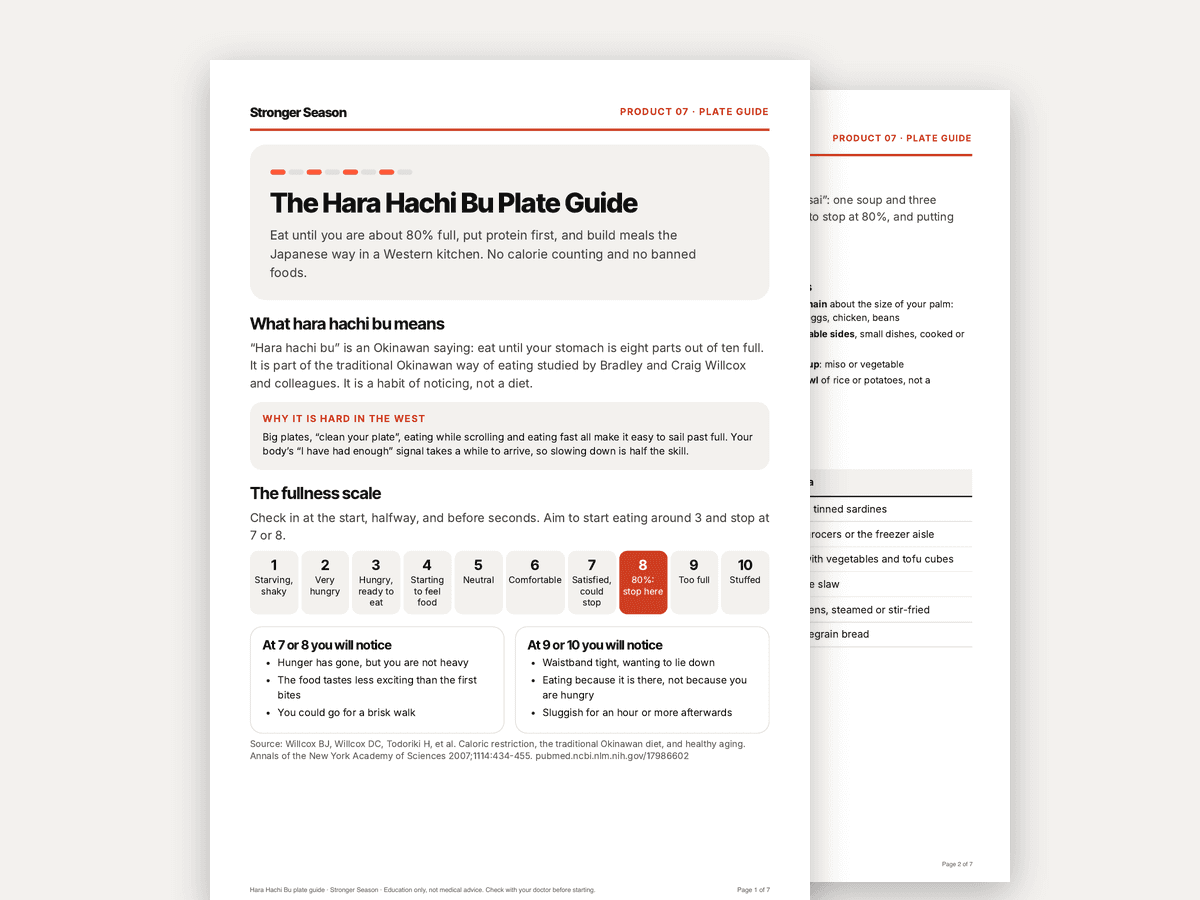 07EatJapan
Hara Hachi Bu Plate Guide & 7-Day Meal Planner
How do I eat to 80% full without counting calories?
The Japanese plate (one soup, three sides) rebuilt for a Western kitchen, a 10-point fullness scale, ten habits, 21 meal ideas, a protein portions page and a fill-in 7-day planner with a shopping list.
PDF guide + fill-in planner 20 minutes to read, then every meal
Why this order works
Four layers. One calm week.
- 1
Daily
Morning Taiso 10, every day, even rest days. It makes you someone who moves every morning.
- 2
Walk
The 3:3 interval walk, four days a week. It builds the engine: heart, lungs and legs.
- 3
Build
Two short strength sessions, never back to back. They build the muscle walking alone does not.
- 4
Eat
Protein first, then stop at 80% full. It gives that muscle something to be built from.
Then measure once a month with the floor test, so you can see the change instead of guessing.
A sample week from the planner
5 free days, 45 minutes, “I walk a bit”
Mon
- Taiso 10
- 3:3 walk
- Strength
- Floor
Tue
- Taiso 10
- 3:3 walk
Wed
- Taiso 10
- Floor
Thu
- Taiso 10
- Strength
- Floor
Fri
- Taiso 10
- 3:3 walk
Sat
- Taiso 10
- 3:3 walk
Sun
- Taiso 10
Built by the actual planner logic in the bundle. Yours changes with your days, minutes and knees.
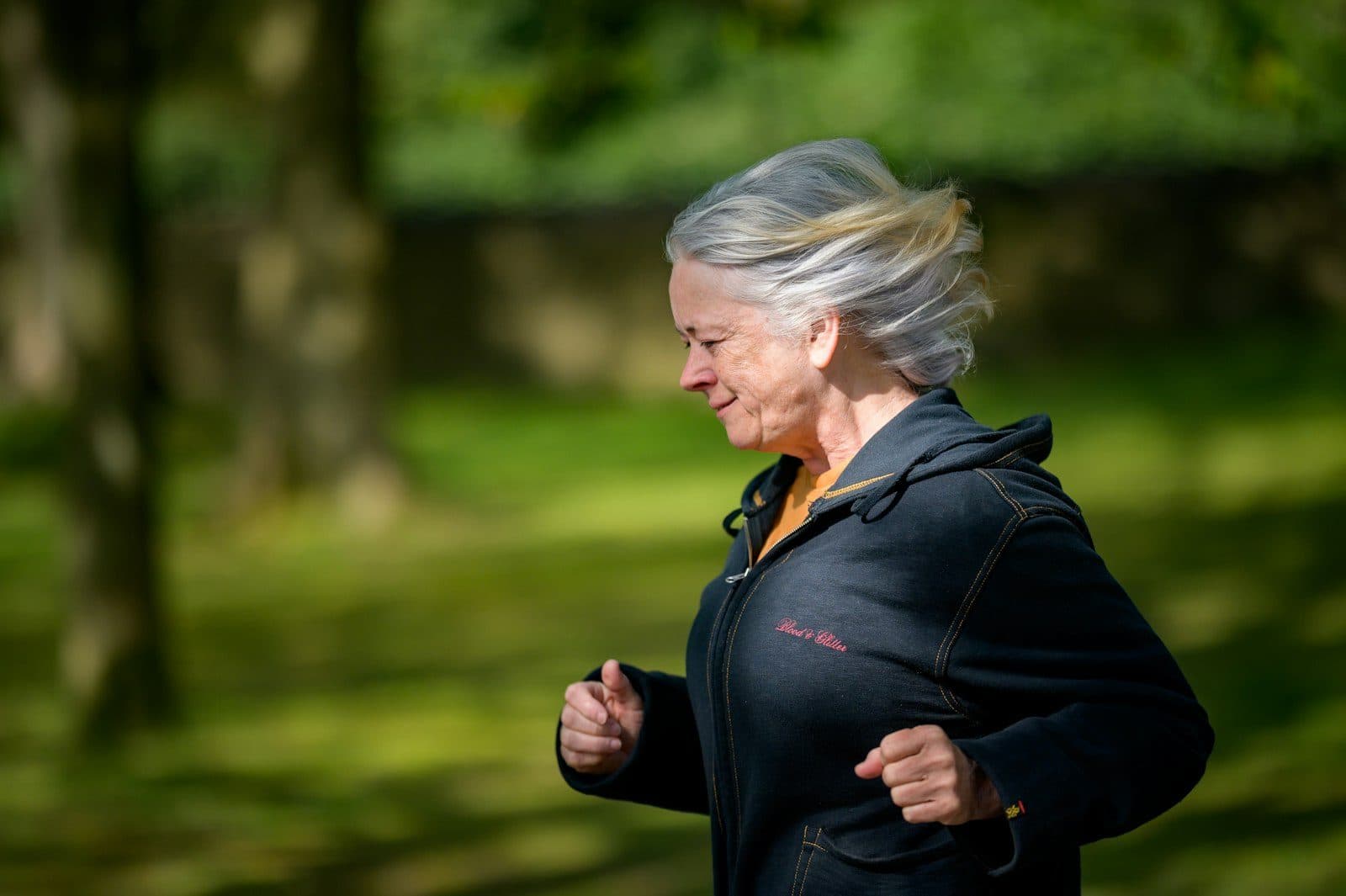
Photo: Centre for Ageing Better / Unsplash
The research, plainly
What the studies actually say
Interval walking beat steady walking
In Shinshu University’s 2007 trial, five months of 3-minute fast and easy intervals raised thigh strength and aerobic fitness and lowered blood pressure more than walking at one moderate pace. Source
Getting up off the floor tells you something
In 2,002 adults aged 51-80, lower scores on the sitting-rising test were associated with higher mortality over about six years. A group pattern, not a personal prediction. Source
Protein needs rise with age
The PROT-AGE group suggests 1.0-1.2 g per kg a day for healthy adults over 65, above the 0.8 g general minimum. Source
Eating to 80% full is a real habit, not a slogan
Hara hachi bu is part of the traditional Okinawan way of eating studied by Willcox and colleagues. Source
Is it right for you?
It is for you if
- You are 40, 50, 60 or older and want to feel stronger and steadier, not smaller.
- You would rather walk, stretch and lift at home than join a gym.
- You like a plan that tells you what to do today, and a way to see progress.
- You are curious how Japanese women stay active so late in life, and want the useful parts.
It is not for you if
- You want fast weight loss or a diet with calorie targets. This bundle makes no weight-loss claims.
- You want video workouts to follow along with. These are planners, trackers and printables, not a video course.
- Your doctor has told you to avoid exercise, or you are recovering from surgery. Get their go-ahead first.
- You already train hard four times a week. You will find most of this too gentle.
Reviews
No reviews yet, and we will not invent any
This is the founding release. After four weeks, buyers will be asked three questions: which tool they used most, what changed in their week, and what was missing. Real answers will appear here, with permission.
Everything included
The whole Stronger Season bundle
| Tool | Value alone |
|---|---|
| Best-of-Both Weekly PlannerIn-page planner + printable pages | $49 |
| 12-Week Interval Walking Plan + CoachIn-page coach and log + printable plan | $79 |
| Morning Taiso 10Printable routine card (PDF) | $29 |
| Home Strength & Balance TrackerSpreadsheet (Excel, Google Sheets, Numbers) | $49 |
| Floor Sit-to-Stand Test & LogIn-page test and log + printable ladder | $39 |
| Protein Plate CalculatorIn-page calculator | $29 |
| Hara Hachi Bu Plate Guide & 7-Day Meal PlannerPDF guide + fill-in planner | $39 |
| Total value | $313 |
Values are what each tool would be priced at if sold on its own. They are not prices anyone has paid.
Founding release
$313 value
$47
One payment. Yours to keep. No subscription.
- Instant access with the code on your receipt
- 4 in-browser tools, 5 PDFs and a spreadsheet
- Works on phone, tablet and computer, kg or lb
- Not included: video workouts, coaching, meal delivery or medical advice
Refunds follow the terms shown at checkout. Delivery is digital: you get the code and link straight away.
Questions
The honest answers
Including the sceptical ones. If yours is not here, the support details are in the footer.
Will this guarantee I get stronger or lose weight?
No. Nobody can honestly promise that. The tools make a well-researched routine easy to start, time, track and repeat. What changes depends on your body, your health and how often you do it. There are no weight-loss claims anywhere in the bundle.
Is this medical advice?
No. Stronger Season is education and planning tools, not medical advice, diagnosis or treatment. If you have a heart condition, high blood pressure, joint problems, osteoporosis, recent surgery or you are simply unsure, check with your doctor before you start. Stop any exercise that causes pain, dizziness or breathlessness that does not settle.
Do I need a gym, equipment or an app?
No gym and no app store. You need comfortable shoes, a sturdy chair, a clear patch of floor, and a phone, tablet or computer with a web browser. A resistance band is optional; a backpack with a few books works for the rows.
I have bad knees. Can I still use it?
Most likely, with your doctor’s OK. Every move has an easier level, the taiso card has a seated version of every move, the walking plan lets “fast” mean brisk rather than hard, and the planner has a gentle-knees setting that swaps floor work for chair work.
Where is my information stored?
In your own browser, on your own device. The tools never send your entries to us or anyone else, and they never ask for your name, health records, a password or bank details. Clearing your browser data clears your entries, so use the print and export buttons to keep a copy.
I live in the UK or Australia. Does it work for me?
Yes. The calculator works in kilograms or pounds, the PDFs print on A4 and fit US Letter, and nothing depends on where you live. Foods are ones you can buy in an ordinary supermarket.
Is this a subscription?
No. One payment, and you keep everything: the in-page tools, the PDFs and the spreadsheet. There is nothing recurring hidden in the price.
How do I get it after I pay?
Your receipt includes an access code and a link to the members page. Enter the code there and every tool and download opens straight away on that device.
Make this your stronger season
A daily habit from Japan, two strength sessions from the West, and a number on the floor test that you can watch go up. All seven tools for $47.